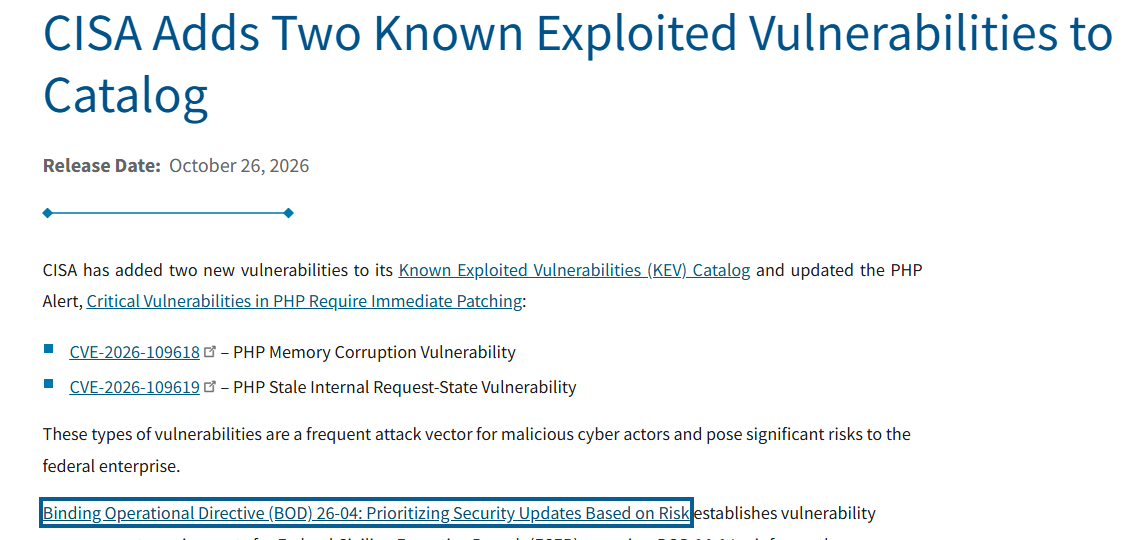
If your vulnerability management program still filters remediation queues strictly by CVSS base scores, CISA's October 28, 2026 Known Exploited Vulnerabilities (KEV) addition is a textbook wake-up call.
As reported by SecurityWeek and detailed in CrowdStrike's 2026 Legal Threat Landscape Report, the China-nexus cyber espionage adversary Warp Panda (also tracked as Armory Castle, UNC5221, Clay Typhoon, and VerdantBamboo) quietly weaponized CVE-2026-41709 — a "low-severity" VMware ESXi insufficient logging flaw carrying a CVSS score of just 2.7 — as a zero-day to blind enterprise audit trails.
Warp Panda Weaponized CVE-2026-41709 to Erase Hypervisor Audit Trails After Lateral Movement
Originally patched on July 29, 2026 under Broadcom Security Advisory VMSA-2026-0006.1, CVE-2026-41709 is an insufficient logging vulnerability in VMware ESXi. While it does not grant initial access on its own, it allows an attacker who already holds administrative privileges on a host to execute sensitive hypervisor operations without generating corresponding audit log entries.
According to SecurityWeek's analysis and CrowdStrike's threat intelligence, Warp Panda integrated this logging blind spot into a disciplined, multi-stage kill chain targeting U.S. organizations — most notably law firms holding sensitive M&A files, litigation strategies, and cross-client communications:
Perimeter Entry via Edge Zero-Days: Warp Panda breaches networks through internet-facing edge appliances (historically targeting Citrix NetScaler, Ivanti Connect Secure, and BeyondTrust Remote Support via CVE-2026-102764).
Pivot to the Virtualization Control Plane: Once inside the perimeter, the threat actor moves laterally to VMware vCenter and ESXi hosts, deploying custom backdoors and implants including BrickStorm, TetanusStorm, SharpStorm, DualGauge, and GuestConduit throughout 2025 and into early 2026.
Audit Evasion via CVE-2026-41709: By exploiting CVE-2026-41709 as a zero-day prior to Broadcom's July 2026 patch, Warp Panda suppressed host-level administrative telemetry so SOC analysts and SIEM rules could not see hypervisor tampering.
Cloud Identity Persistence: Alongside hypervisor stealth, the group harvested cloud session tokens to access Microsoft 365 environments without triggering credential alerts and registered rogue multi-factor authentication (MFA) devices on compromised accounts to survive password resets.
Broadcom's VMSA-2026-0006 Advisory Spans Both Pre-Auth Entry and Post-Compromise Stealth
When Broadcom published VMSA-2026-0006.1 on July 29, 2026, most security teams focused exclusively on the critical vulnerabilities in the bundle. Now, three separate flaws from that single advisory have confirmed in-the-wild exploitation:
Three distinct CVEs are currently dominating the virtualization threat landscape:
CVE-2026-41709 (VMware ESXi / Cloud Foundation)
At first glance, a CVSS of 2.7 (Low) for "Insufficient Logging" or "Audit Bypass" might easily fall to the bottom of a vulnerability management queue. However, context is everything. Warp Panda exploited this flaw as a zero-day throughout 2025 and 2026 to silently cover their tracks while operating inside compromised environments. CISA added it to their Known Exploited Vulnerabilities (KEV) catalog on October 28, 2026, mandating federal civilian agencies patch by November 11, 2026.
CVE-2026-59309 (VMware vCenter Server - vmdir)
This Critical 9.8 flaw allows for authentication bypass within the vCenter Directory (vmdir). Incident responders at Rapid7 and Quirso observed this vulnerability being exploited in the wild to grant unauthorized attackers administrative control over the virtualization management plane, effectively handing over the keys to the entire datacenter.
CVE-2026-59310 (VMware vCenter Server)
Also carrying a 9.8 Critical severity, this directory traversal vulnerability leads directly to RCE. A China-linked APT actively used this flaw in August and September 2026 to compromise approximately 360 web-exposed vCenter servers, deploying SSH reverse shells to maintain persistent backdoor access.
Patched builds that resolve CVE-2026-41709 include VMware ESXi-9.1.0.0-25370933, ESXi-9.0.2.0100-25595025, ESXi80U3j-25429389, and VMware Cloud Foundation 5.2.4. Federal Civilian Executive Branch (FCEB) agencies must remediate by November 11, 2026 under Binding Operational Directive (BOD) 22-01.
Mapping the Attack to Testable ISC2 CISSP and CCSP Certification Domains
Real-world nation-state tradecraft rarely stays inside a single technical silo. If you are preparing for or maintaining your CISSP or CCSP, the Warp Panda campaign connects directly to several high-weight exam objectives.
CISSP Domain 1: Security and Risk Management (16%)
The Concept: 5 Pillars of Information Security (1.2) & Risk Management Concepts (1.9)
How it Applies: Suppressing administrative logs directly attacks Nonrepudiation and Accountability. Relying solely on a 2.7 CVSS score without threat context illustrates the difference between raw vulnerability ratings and true Contextual Risk Analysis.
Exam Mindset Callout (Think Like a Manager): On the CISSP exam, remember that a vulnerability's severity score is only one variable in the risk equation. True risk management requires contextual analysis of the threat environment. Furthermore, without accountability and nonrepudiation mechanisms, a security model inherently fails.
CISSP Domain 5: Identity and Access Management (13%)
The Concept: AAA, Session Management, MFA (5.2) & Provisioning Lifecycle & Privilege Escalation (5.5)
How it Applies: Stealing Microsoft 365 session tokens bypasses primary authentication checks, and registering a rogue MFA device abuses enrollment workflows to maintain persistent Authorization across password resets.
Exam Mindset Callout: MFA is not a silver bullet if the enrollment process is flawed. The exam will test your understanding of the identity lifecycle—if an attacker compromises the provisioning phase (by registering a rogue device), they effectively own the authorization chain regardless of subsequent password resets.
CISSP Domain 7: Security Operations (13%)
The Concept: Investigations & Digital Forensics (7.1), Logging & Monitoring (7.2), and Patch & Vulnerability Management (7.8)
How it Applies: Exploiting CVE-2026-41709 breaks the evidentiary chain required for root-cause forensics and SIEM correlation, while CISA's KEV mandate forces risk-based patch reprioritization.
Exam Mindset Callout: The exam emphasizes that digital forensics requires an unbroken chain of custody and immutable evidence. When an attacker can manipulate local logs, you lose the ability to perform valid root-cause analysis, highlighting the mandate for centralized, write-once-read-many (WORM) logging.
CCSP Domain 3: Cloud Platform and Infrastructure Security (17%)
The Concept: Virtualization & Hypervisor Security; Management Plane Isolation
How it Applies: Compromising vCenter and ESXi targets the foundational Type 1 Hypervisor and cloud management plane, threatening multi-tenant guest isolation and enabling covert traffic tunneling via implants like GuestConduit.
Exam Mindset Callout (Think Like a Cloud Architect): In cloud architectures, the hypervisor and management plane are the keys to the kingdom. The CCSP exam heavily stresses that management interfaces must be strictly isolated from tenant data planes and the public internet to prevent hypervisor-level compromises.
CCSP Domain 5: Cloud Security Operations (17%)
The Concept: Continuous Monitoring, Log Integrity & Forensics in Virtualized Environments
How it Applies: Demonstrates why hypervisor logs cannot be trusted solely on the local host; out-of-band network telemetry (NDR) and immutable remote log forwarding are mandatory when the management plane is contested.
Exam Mindset Callout: The exam will test your operational resilience. If a host is compromised, its local logs are instantly untrustworthy. Centralized, immutable log forwarding (such as a SIEM deployed outside the contested environment) is required for operational integrity.
CISSP Domain 1 (Security and Risk Management) & Domain 7 (Security Operations)
Why CVSS != Risk
In CISSP Domain 1.2, ISC2 emphasizes the Five Pillars of Information Security: Confidentiality, Integrity, Availability, Authenticity, and Nonrepudiation. While CVE-2026-41709 does not directly corrupt guest VM memory or crash a host, it destroys nonrepudiation and accountability at the hypervisor layer. If an attacker with stolen administrative credentials can execute privileged ESXi actions without leaving an audit record, your detective controls fail silently.
Furthermore, under CISSP Domain 1.9 (Risk Management) and Domain 7.8 (Patch and Vulnerability Management), this incident exposes a classic operational trap: treating CVSS base scores as equivalent to organizational risk. CVSS measures technical severity in isolation (and scores CVE-2026-41709 at 2.7 because it requires prior administrative privileges and only impacts logging). However, Risk = Threat × Vulnerability × Impact. Once a threat actor chains an edge zero-day or CVE-2026-59309 / CVE-2026-59310 to obtain admin privileges, that "low-severity" logging flaw becomes a high-impact force multiplier for long-term espionage.
Exam Mindset Callout (Think Like a Manager): On the CISSP exam, if a question asks how to prioritize patching when a low-CVSS vulnerability is actively exploited against your sector, never choose "defer until the next quarterly maintenance window based on CVSS." Threat intelligence and active exploitation (such as inclusion in the CISA KEV Catalog) immediately elevate likelihood to near-certainty, requiring emergency change management and compensating detective controls.
CCSP Domain 3 (Cloud Platform & Infrastructure Security) & Domain 5 (Cloud Security Operations)
Defending the Hypervisor Control Plane
Under the August 2026 ISC2 CCSP Exam Outline, Domain 3 (Cloud Platform and Infrastructure Security, 17%) and Domain 5 (Cloud Security Operations, 17%) heavily test the security of the virtualization layer and management plane. In a private or hybrid cloud built on VMware vSphere or Cloud Foundation, ESXi is the Type 1 (bare-metal) hypervisor and vCenter is the centralized management plane.
Warp Panda's toolset — specifically BrickStorm, DualGauge, and GuestConduit — targets the exact architectural choke points CCSP candidates study:
- Management Plane Exposure: Around 360 vCenter servers compromised in the CVE-2026-59310 wave were directly reachable from the public internet. In CCSP architecture design, management interfaces (vCenter, ESXi DCUI/SSH, VAMI) must be strictly isolated on out-of-band (OOB) management networks behind bastion hosts or Zero Trust Network Access (ZTNA) brokers.
- Compensating Controls for Blinded Host Logs: When CVE-2026-41709 prevents ESXi from writing certain admin actions to local or syslog streams, host-based logging alone fails Defense in Depth (CISSP Domain 3.1). CCSP Domain 5 requires layering independent telemetry — such as east-west Network Detection and Response (NDR), hypervisor configuration drift detection, and hardware root-of-trust (TPM) attestation — so unauthorized hypervisor changes are caught even if the audit daemon stays quiet.
Exam Mindset Callout (Shared Responsibility Model): For private cloud, on-premises ESXi, or bare-metal IaaS deployments, the customer owns hypervisor patching and management plane segmentation. In public IaaS/PaaS/SaaS, the Cloud Service Provider (CSP) manages the underlying hypervisor, while the customer remains responsible for identity federation, session token protection, and MFA enrollment policies.
CISSP Domain 5 (Identity and Access Management)
Session Token Theft and Rogue MFA Persistence
CrowdStrike's report highlights that Warp Panda didn't stop at the hypervisor: they harvested cloud session tokens to access Microsoft 365 without triggering credential prompts and registered unauthorized MFA devices to survive password resets. This maps directly to CISSP Domain 5.2 (Identification and Authentication Strategy) and CCSP Domain 4 (Cloud Application Security - Identity Federation):
Session Hijacking (Pass-the-Cookie / Token Replay)
Stealing an active session token bypasses primary authentication and MFA entirely because the Policy Decision Point (PDP) has already issued a bearer token. Mitigating this requires Continuous Access Evaluation (CAE), token binding, and device-state conditional access policies.
MFA Registration Abuse
Registering a new authenticator app or hardware token on an already compromised account is an Identity Lifecycle and Provisioning failure (CISSP Domain 5.5). Adding a new MFA factor must be treated as a privileged administrative action requiring step-up verification, restricted network locations, and immediate out-of-band alerting to the SOC and end user.
Practitioner Hardening Checklist for Enterprise and Federal Environments
Whether you are securing an enterprise data center, managing federal infrastructure aligned with NIST SP 800-53, or applying CISSP/CCSP principles in production, take these concrete steps right away:
Apply Broadcom VMSA-2026-0006.1 Patches Immediately
Upgrade to ESXi-9.1.0.0-25370933, ESXi-9.0.2.0100-25595025, ESXi80U3j-25429389, or VMware Cloud Foundation 5.2.4 ahead of CISA's November 11, 2026 KEV deadline — and verify that vCenter is patched against CVE-2026-59309 and CVE-2026-59310.
Audit for Retroactive Compromise (NIST SP 800-53 AU-6 / SI-4)
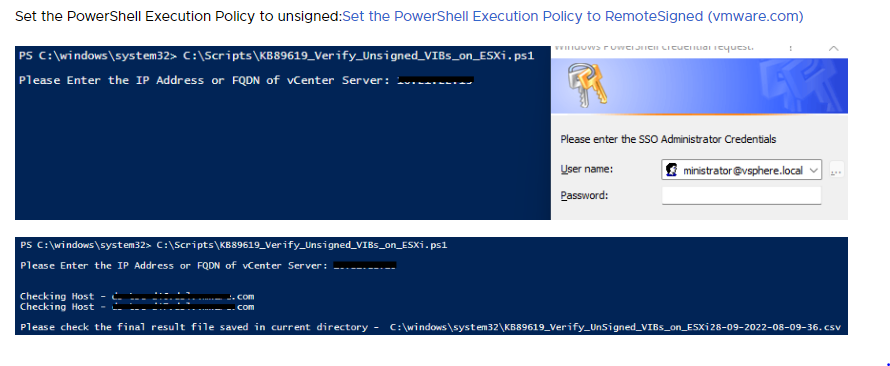
Because CVE-2026-41709 suppresses specific ESXi admin logs, do not rely solely on clean syslog records to rule out compromise. Inspect vCenter/ESXi hosts for unauthorized VIBs, unexpected rogue binaries (such as BrickStorm or SharpStorm), anomalous SSH reverse shells, and unscheduled configuration drift.
Eliminate Direct Internet Exposure of the Management Plane (NIST SP 800-53 SC-7)
Verify that no vCenter Server or ESXi management interface is exposed to the public internet, and enforce strict micro-segmentation between edge appliances (VPNs, load balancers) and the virtualization management VLAN so an edge zero-day cannot pivot directly to vCenter.
Lock Down Cloud Session Tokens and MFA Enrollment (NIST SP 800-53 IA-2 / AC-2)
Enforce token-binding/device-compliant Conditional Access policies in Microsoft Entra ID / M365, require phishing-resistant MFA (FIDO2/WebAuthn) for all administrative roles, and configure high-priority SIEM alerts for any new MFA device registration or privileged role assignment.
Did you enjoy CarlsCloud.com™ today and did I help you at all?
If so, buy me a coffee or just shoot me a note via LinkedIn to say thanks it would mean a lot! -Carl