By Carl Ballenger, CISSP, CCSP
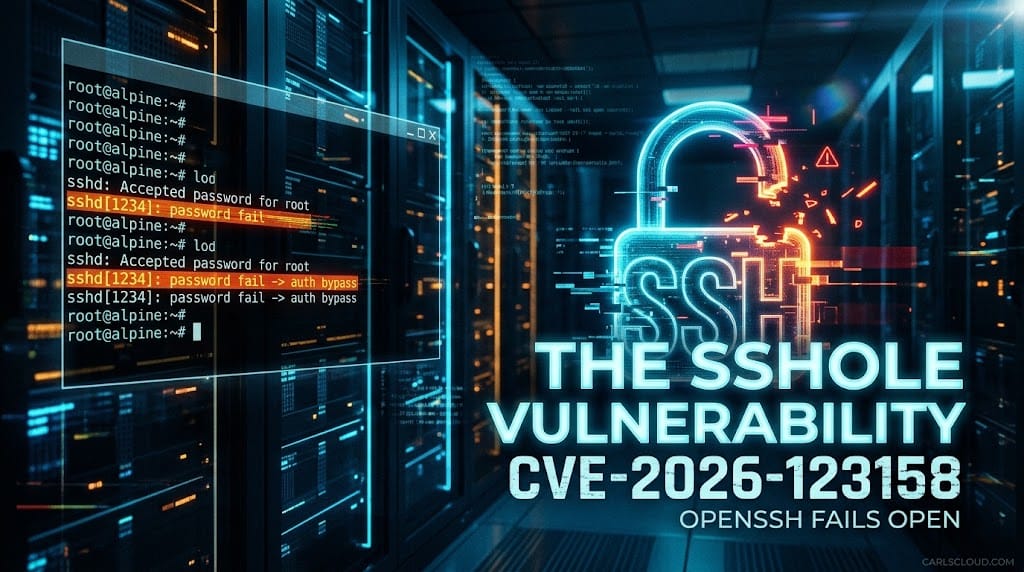
Imagine disabling password authentication on a system account to make it more secure, only to have a threat actor use that exact configuration to walk right in without a password. That’s the reality of the newly disclosed OpenSSH vulnerability dubbed "SSHole" (CVE-2026-123158, CVSS 8.1), which saw active exploitation in the wild less than nine hours after its public release.
For cloud architects and security engineers—particularly those running lightweight Alpine Linux containers—this is a prime example of why secure defaults, defense in depth, and proper error handling are absolutely paramount.
Did CarlsCloud.com™ content help you at all today? My goal is to bring your information security certification and educational goals forward!
If so, buy me a coffee to pay it forward or simply just shoot me a note via LinkedIn to say thanks it would mean a lot! -Carl Ballenger
The Technical Breakdown: What Happened and Why It Matters
This vulnerability fundamentally breaks the assumption that an account with a disabled password is secure from authentication-based attacks.
The Flaw (CVE-2026-123158)
The vulnerability impacts Linux systems running OpenSSH compiled with the musl C library where Pluggable Authentication Modules (PAM) are disabled. This happens to be the default configuration for Alpine Linux, a massively popular distribution used for cloud-native Docker containers.
The Mechanics
When an unauthenticated attacker supplies an intentionally oversized password (between 257 and 1,024 bytes), the OpenSSH password-hashing operation fails. However, due to a legacy patch introduced in 2016 to fix a username enumeration issue, this failure incorrectly returns an asterisk (*).
The Exploit
In Linux, if an account is deliberately configured without a usable password, its password hash field in the shadow file is stored as an asterisk (*). The sshd daemon compares the failed hash output (*) to the stored shadow value (*). Because they match, OpenSSH grants a successful login.
The Impact
Threat intelligence firm Previdian detected active exploitation from a Japanese IP address just hours after disclosure. Attackers bypassed authentication, gained root access on an Alpine Linux honeypot, and executed reconnaissance commands over non-interactive SSH sessions.
(Note: This does not affect Dropbear, glibc-based distributions, or systems where passwords are checked via PAM).
Through the CISSP and CCSP Lens
For ISC2 practitioners studying for or maintaining their certifications, SSHole is a fascinating case study in exception handling, identity management, and cloud architecture.
CISSP Domain 3: Security Architecture and Engineering
Exam Concept: Fail Securely (Fail-Safe) & Exception Handling
The Breakdown
The core engineering failure here is a direct violation of the "fail securely" principle. When the password hashing algorithm failed due to the oversized input, the system caught the error but failed into a state that overlapped with a legitimate administrative configuration (* meaning "account disabled"). Exception handling should never output a value that can be misinterpreted as a successful system state.
Exam Mindset Callout (Think Like an Architect)
When designing or evaluating systems on the CISSP exam, remember that errors and exceptions must default to a deny or closed state (fail-safe). If a failure state outputs a wildcard or an administrative flag, it creates a critical vulnerability.
CISSP Domain 5: Identity and Access Management (IAM)
Exam Concept: Authentication and Policy Enforcement
This vulnerability effectively turns a mitigating control (disabling passwords for service accounts) into a direct attack vector. It bypasses the Policy Enforcement Point (PEP) because the underlying logic of the authentication system was flawed.
CCSP Domain 3: Cloud Platform and Infrastructure Security
Exam Concept: Container Security & Secure Baselines
The Breakdown
Because Alpine Linux is the foundational image for millions of Docker containers due to its small footprint (musl libc), this vulnerability disproportionately affects cloud-native environments. It highlights the widespread risk of base-image dependencies in cloud infrastructure.
Test Your Knowledge: CISSP / CCSP Practice Question
A security architect is analyzing a recent breach where an attacker bypassed authentication on a lightweight cloud container. The attacker intentionally submitted an abnormally long password string, which caused the authentication module's hashing function to crash. The crashed function returned a default error character (*) which perfectly matched the container's stored password hash for disabled accounts, granting the attacker root access. Which core security design principle did the authentication module violate?A) Defense in Depth
B) Least Privilege
C) Fail Securely (Fail-Safe)
D) Separation of Duties
Looking for the solution?
This content only available to CarlsCloud.com subscribers. Subscribe now FREE and have access to exclusive CISSP/CCSP mock exam content and the latest information security updates.
Sign up nowAlready have an account? Sign in