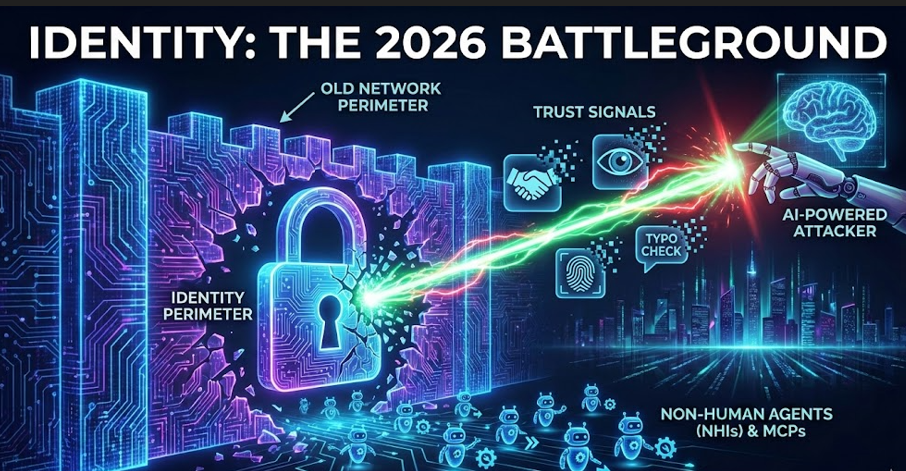
If you’ve been following the industry chatter today, you know the narrative has shifted. For years, we (especially those of us with a CISSP/CCSP background) have treated Identity as the "new perimeter." But a new report from SC Media suggests that even this perimeter is dissolving.
The consensus for 2026 is clear: Identity is the battlefield, but the rules of engagement have changed. Attackers are no longer just breaking into networks; they are logging in. And they are using AI to do it with a level of sophistication that erases the "trust signals" we’ve relied on for decades.
Here is my breakdown of the key takeaways from the SC Media feature and what it means for cloud security professionals.
The "Trust Signal" is Dead
We used to tell users to "look for the typo." We trained them to spot awkward phrasing or slight mismatches in email domains. That advice is now obsolete.
With the maturity of AI-driven phishing and deepfakes, the "human" tells are gone. AI agents can now generate perfectly grammatical, context-aware lures that are indistinguishable from legitimate communications.
- The Threat: Real-time impersonation. It’s not just a fake email anymore; it’s a deepfake video call from your "CEO" or a realistic voice clone authorizing a wire transfer.
- The Reality: If your defense strategy relies on users "spotting" the phish, you have already lost.
The Explosion of Non-Human Identities (NHIs)
As cloud architects, we know that for every human user, there are dozens of service accounts, API keys, and bots. In 2026, this "non-human" population is exploding due to Agentic AI.
- The Problem: AI agents (like those connected via MCP) need permissions to act. They need to read files, access databases, and trigger workflows.
- The Risk: These agents effectively become high-speed, autonomous users. When they are compromised (or "hallucinate" into unauthorized actions), they don't just leak data—they execute actions at machine speed.
The "MCP" Trap
The article highlights a critical technical gap regarding the Model Context Protocol (MCP). While MCP is fantastic for interoperability (making it the "USB-C of AI"), it was not built with security as a primary primitive.
- Nancy Wang (1Password) puts it bluntly: "MCP is not a security standard. It was designed for interoperability... Once an agent connects, it's effectively operating with the same access as the user who configured it."
- CarlsCloud Take: This is the new "Over-Privileged Service Account." If you are deploying MCP-connected agents in your enterprise, you are effectively creating a new attack surface that bypasses traditional IAM governance.
What We Need to Do (The Fix)
The "Castle-and-Moat" is gone. We need to move to an Identity-First posture that assumes the user might be an AI imposter.
- Kill the Password: It is time to aggressively adopt Passkeys and FIDO2. Phishing-resistant auth is no longer "nice to have"; it is the baseline.
- Verify Behavior, Not Just Creds: Since valid credentials can be stolen or simulated, we need "invisible authentication"—systems that continuously verify who is behind the keyboard based on behavioral biometrics and context, not just the initial login.
- Secure the Non-Humans: Treat AI agents like privileged users. Apply strict Least Privilege (PoLP) and short-lived tokens to any MCP connection.
🔗 Further Reading
To dig deeper into these concepts, check out these sources:
- Identity Becomes the 2026 Battleground (SC Media) - The original feature article analyzing the 2026 identity crisis.
- NIST SP 800-63-4 Digital Identity Guidelines (NIST) - The authoritative standard on identity proofing and federation, recently updated to address modern threats.
- Plug, Play, and Prey: Security Risks of MCP (Microsoft) - A technical deep dive into how attackers exploit the Model Context Protocol.
Securing MCP Servers: What You Need to Know - AI Explainer Series