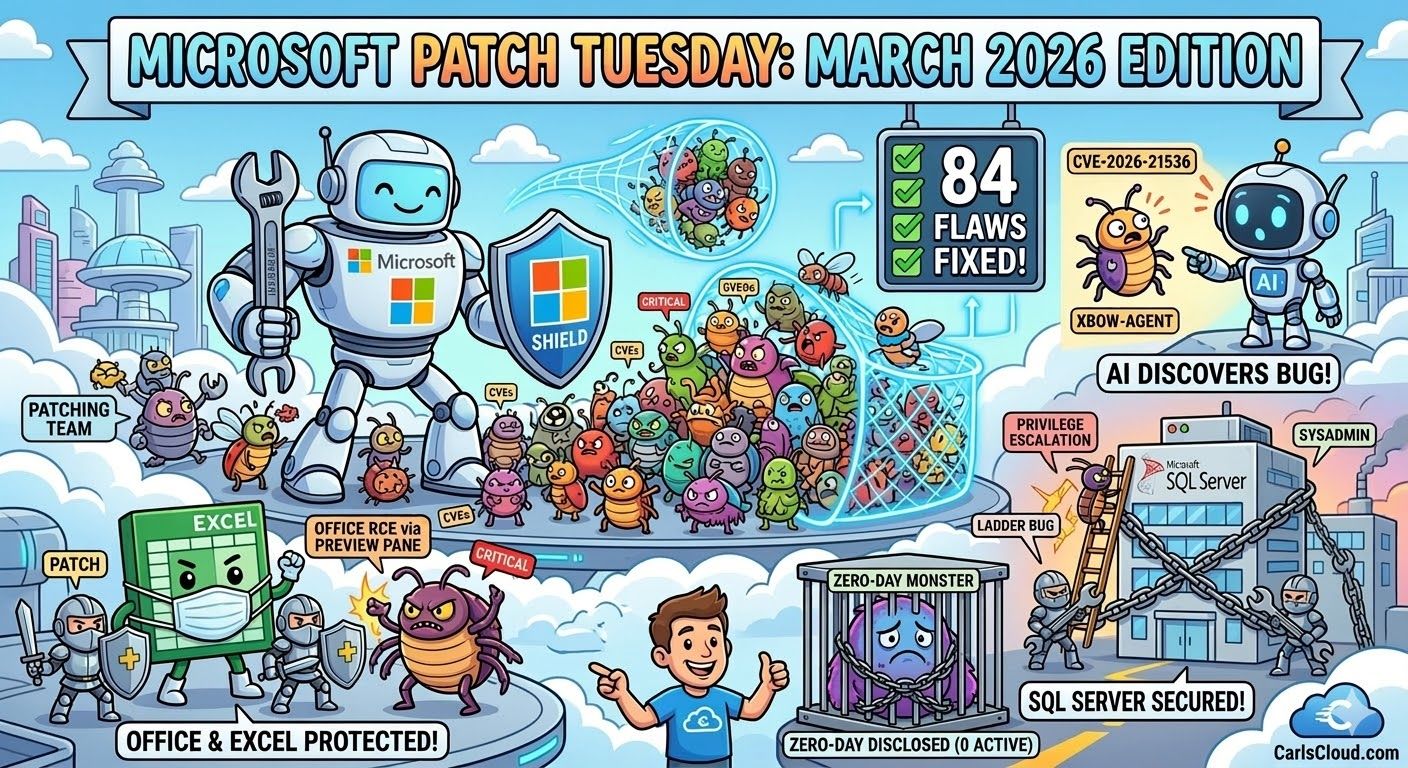
Patch Tuesday is back, and this month, it is an absolute mammoth. If you have been putting off those system updates, now is the time to take action.
Microsoft has just rolled out software updates to fix a staggering 167 security vulnerabilities across its Windows operating systems and related software.
This marks the second-largest Patch Tuesday in the company's history.
But Microsoft is not the only tech giant patching critical holes this month. We are also tracking emergency zero-day updates for Google Chrome and Adobe Reader.
Let us dive into the key vulnerabilities you need to know about and how to secure your network today.
April 2026 - Microsoft Security Update Guide
Critical Microsoft Updates: SharePoint and BlueHammer
With 167 fixes, Microsoft's April 2026 release is massive. It includes nearly 60 browser vulnerabilities alone. According to Adam Barnett, lead software engineer at Rapid7, this sets a new record in that category. Barnett notes that it might be tempting to tie this sudden spike to the recent buzz around Project Glasswing—a highly anticipated, unreleased AI capability from Anthropic that reportedly excels at finding bugs. However, since Microsoft Edge is based on Chromium, the Chromium maintainers are acknowledging a wide range of researchers for these vulnerabilities. Still, Barnett safely concludes that this increase in volume is driven by ever-expanding AI capabilities, and we should expect vulnerability reporting to keep growing as AI models become more capable.
Among these numerous updates, two critical Microsoft flaws demand your immediate attention:
The SharePoint Server Zero-Day (CVE-2026-32201) https://nvd.nist.gov/vuln/detail/CVE-2026-32201)
Microsoft is warning users that attackers are already actively targeting CVE-2026-32201 (https://nvd.nist.gov/vuln/detail/CVE-2026-32201), a vulnerability within Microsoft SharePoint Server. This flaw allows malicious actors to spoof trusted content or interfaces over a network.
Mike Walters, president and co-founder of Action1, explains that this vulnerability can be used to deceive employees, partners, or customers by presenting falsified information right inside trusted SharePoint environments. Walters points out that this can enable phishing attacks, unauthorized data manipulation, or social engineering campaigns that lead to further compromise. Because there is active exploitation, organizational risk is significantly increased. If your organization relies on SharePoint, applying this update is critical.
Windows Defender's BlueHammer Bug (CVE-2026-33825) (https://nvd.nist.gov/vuln/detail/CVE-2026-33825)
Microsoft also addressed a privilege escalation vulnerability in Windows Defender dubbed "BlueHammer," officially tracked as CVE-2026-33825 (https://nvd.nist.gov/vuln/detail/CVE-2026-33825). Exploit code for this bug was recently published online by a security researcher who grew frustrated with Microsoft's response time. Fortunately, Will Dormann, senior principal vulnerability analyst at Tharros, confirmed that the public BlueHammer exploit code no longer works after installing today's patches.
Major Fixes for Adobe Reader and Google Chrome
Microsoft was not the only company busy patching vulnerabilities this month. Whether you are viewing PDFs or just browsing the web, you need to ensure your third-party applications are up to date.
Adobe Reader Emergency Update (CVE-2026-34621) (https://nvd.nist.gov/vuln/detail/CVE-2026-34621)
Adobe released an emergency update on April 11 to fix an actively exploited flaw that could lead to remote code execution. Satnam Narang, senior staff research engineer at Tenable, noted that there are indications this specific zero-day vulnerability, CVE-2026-34621 (https://nvd.nist.gov/vuln/detail/CVE-2026-34621), has been seeing active exploitation in the wild since at least November 2025. If you use Adobe Reader, ensure the software is updated immediately to close this dangerous backdoor.
Google Chrome's Fourth Zero-Day of 2026 (CVE-2026-5281) https://nvd.nist.gov/vuln/detail/CVE-2026-5281)
Finally, no matter what browser you use to surf the web, it is vital to completely close out and restart it periodically. It is easy to put off—especially if you have dozens of tabs open—but restarting is the only way to ensure updates actually install. For instance, a Google Chrome update released earlier this month fixed 21 security holes, including a high-severity zero-day flaw tracked as CVE-2026-5281 (https://nvd.nist.gov/vuln/detail/CVE-2026-5281).
*This marked Chrome's fourth zero-day patch of 2026.
This month's record-breaking patch load is a stark reminder of how quickly the cybersecurity landscape is evolving. With AI making it easier to discover software vulnerabilities, we can expect these massive update cycles to become the new normal.
Your next steps are simple: apply your Windows updates, check Adobe Reader for pending patches, and completely restart your web browsers.
Did you enjoy CarlsCloud™ today and did I help you at all?
If so, buy me a coffee or just shoot me a note via LinkedIn to say thanks it would mean a lot!